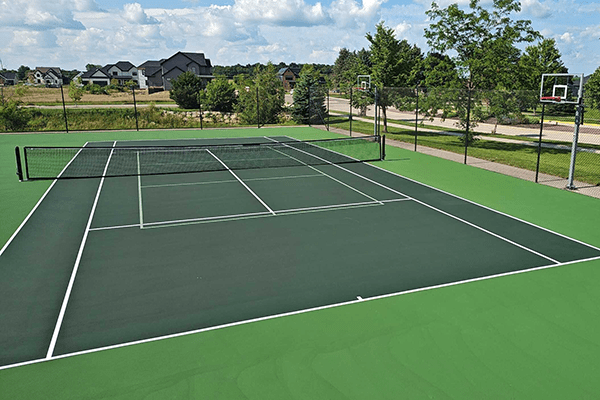
I remember the first time I stepped onto a proper tennis court. It wasn’t Wimbledon or anything — just a well-kept municipal court tucked behind a schoolyard. But man, that feeling. The clean bounce of the ball, the faint smell of fresh paint on the lines, and the smoothness of the ground underfoot — it was magic. Years later, I’ve come to appreciate what goes into creating that experience. Behind every satisfying serve or backhand rally, there’s more than just passion. There’s craftsmanship, planning, and a surprising variety of choices — especially when it comes to the surface you play on.
Let’s talk about what it really takes to build a modern tennis court. And yes, we’ll get into the ground stuff (literally) like what synthetic flooring means, why it matters, and who’s making it happen.
It’s Not Just a Court, It’s a Craft
You’d think building a tennis court is just slapping some paint on concrete, right? Not quite. The best tennis court builders don’t just pour concrete and call it a day. They’re part engineer, part artist — working with precise measurements, understanding local weather patterns, drainage, and even the type of players expected to use the court.
Think about it: a school might need a highly durable surface that holds up against aggressive teen wear and tear. A private homeowner might want a premium surface that looks sleek and feels even better. And professional venues? They want perfection. Every layer beneath the court has a purpose — from compacted sub-base to leveling layers to surface coatings. The goal? Consistency. And no surprises mid-serve.
Good builders factor in everything. Shade. Wind. Slopes. And let’s not forget about the budget. There’s always a budget, and smart contractors know how to work within it without compromising on playability or safety. That’s a skill — one that comes with experience, not just blueprints.
Let’s Talk About Surfaces – Because It’s a Big Deal
If you’ve never thought about what you’re playing on, you’re not alone. Most people don’t. But there’s a world of difference between grass, clay, and hard courts. And within that hard court category? There’s a whole subset of materials that can make or break your playing experience.
One of the most popular choices today — especially in clubs, schools, and public parks — is synthetic acrylic flooring. It might not sound fancy, but this stuff is a game-changer.
Why? Well, it balances cost, durability, and performance. It’s easier on the joints than concrete, has solid grip even in light rain, and doesn’t need the high maintenance that natural surfaces demand. And it’s customizable. You want a little more cushion? Done. A brighter color palette? No problem. It’s that blend of function and flexibility that makes it a go-to for many.
But beyond the technicalities, there’s something comforting about playing on a surface that feels consistent — no weird bounces, no cracks mid-court, just pure game. You can focus on your forehand instead of your footing, and that’s the whole point.
From Blueprint to Baseline: The Process
Now, for those wondering what actually happens when a new tennis court is built — it’s more than just pouring some asphalt. It starts with groundwork (literally), which involves clearing and leveling the land. Depending on soil quality, drainage systems might be needed to prevent water pooling. No one wants a soggy baseline.
Then comes the base — usually crushed stone or concrete — followed by several coats of acrylic layers if you’re going the synthetic route. Each layer is applied with care, smoothed, and left to cure before the next one is added. It’s a bit like making a lasagna, if your lasagna had to survive a heatwave and a hundred tennis shoes every weekend.
Color coatings, line markings, net posts — it all comes in toward the end. And suddenly, a patch of land becomes a place where games are played, lessons are learned, and friendships are made.
Why Tennis Courts Are More Than Just Sports Venues
There’s something romantic about a tennis court. Maybe it’s the way they look — clean lines, open space, the promise of movement and challenge. Or maybe it’s what they represent. Discipline. Community. Time spent outside, away from screens.
In schools, courts become social hubs. In neighborhoods, they’re where kids learn patience and hand-eye coordination. For older folks, they’re a way to stay fit and connected. It’s not just about competition — it’s about accessibility. A well-built court invites everyone, from pros to newbies.
That’s why I always respect the folks who build them. They’re not just laying down layers of material. They’re shaping moments. Memories. Heck, maybe even futures.
So, Who’s Paying Attention to the Details?
It’s easy to overlook the behind-the-scenes work. People often forget that good tennis courts don’t just appear overnight. They’re the result of smart design, skilled labor, and sometimes even local partnerships between schools, municipalities, and sports councils.
There’s also a growing emphasis on sustainability. Builders are now choosing eco-friendly materials, better drainage methods to conserve water, and UV-stable coatings that hold up longer — meaning less repainting and fewer chemicals.
Also worth mentioning: access. Many communities are investing in multi-purpose courts that can double for pickleball or basketball. It’s about making the most out of a space. Efficient and inclusive — that’s the future.
The Heart of It All
Look, whether you’re a die-hard tennis lover or just someone who likes a casual rally on weekends, the quality of your court matters. It affects how you play, how you feel, and whether you’ll come back.
That’s why paying attention to the people building them — and the materials they’re using — is worth your time. Behind that clean surface is a web of choices, each one affecting the game above it.
So next time you step onto a court, take a second to notice the details. The bounce. The color. The grip. Because someone, somewhere, cared enough to get it just right.
 Site Title
Leave a comment